Publicidad
Java Programming 10-Minute – Mark Watson | Libro + Solucionario

Java Programming 10-Minute – Mark Watson | Libro + Solucionario

Descargar libroVer contenido

Descripción

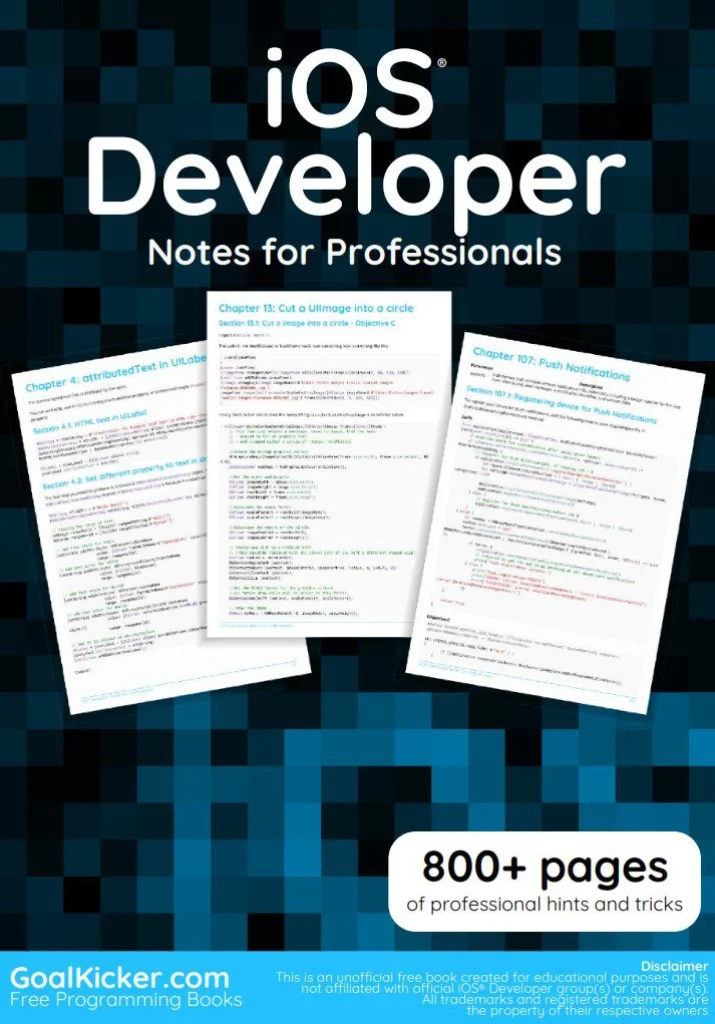
Guía técnica diseñada para ofrecer una visión clara, práctica y organizada del desarrollo de aplicaciones iOS, enfocada en proporcionar a desarrolladores una referencia directa y efectiva en contextos profesionales. Estructurada en módulos independientes, cubre desde los elementos esenciales del lenguaje Swift y el uso de Xcode, hasta temas avanzados como arquitecturas MVC y MVVM, manejo de vistas con UIKit y SwiftUI, persistencia de datos, redes, animaciones, notificaciones y buenas prácticas de interfaz de usuario móvil.

Contenido colaborativo y actualizado por desarrolladores con experiencia real en iOS, incluye fragmentos de código completos y bien anotados que ilustran patrones comunes en aplicaciones reales, como consumo de API mediante URLSession o Alamofire, almacenamiento local con Core Data y UserDefaults, implementación de autenticación biométrica (Face ID/Touch ID), así como integración con servicios externos como Firebase y Apple Push Notifications. Orientado a funcionar como una herramienta operativa más que un manual académico, permite acceder rápidamente a soluciones eficaces durante el desarrollo, preparar revisiones de código o entrevistas técnicas, y abordar problemas comunes en el diseño de experiencias móviles.

En lugar de enseñar paso a paso desde cero, este recurso destaca por su enfoque funcional: ayuda a escribir código limpio, eficiente y alineado con los estándares del ecosistema iOS, fomentando la productividad y el dominio de conceptos modernos en desarrollo móvil. Perfecta para desarrolladores intermedios y avanzados, así como para profesionales que migran de otras plataformas, esta guía representa un compendio condensado del conocimiento esencial en creación de apps con Swift, Xcode y frameworks nativos, pensado para resolver dudas rápidamente y estar al día con las mejores prácticas del mundo Apple.

Qué aprenderás con este libro

Con este libro aprenderás de manera clara y estructurada los fundamentos de Java Programming 10-Minute. Dominarás el análisis de chapter 1: getting started with ios development, las aplicaciones de •section 1.1: creating a default single view application y la correcta interpretación de •section 1.2: hello world, convirtiéndose en una guía clave para tu aprendizaje y consulta continua en Programación en Java.

Tabla de contenido

Chapter 1: Getting started with iOS Development
•Section 1.1: Creating a default Single View Application
•Section 1.2: Hello World
•Section 1.3: Xcode Interface
•Section 1.4: Create your first program in Swift 3
Chapter 2: UILabel
•Section 2.1: Create a UILabel
•Section 2.2: Number of Lines
•Section 2.3: Set Font
•Section 2.4: Text Color
•Section 2.5: Background Color
•Section 2.6: Size to fit
•Section 2.7: Text alignment
•Section 2.8: Calculate Content Bounds (for dynamic cell heights)
•Section 2.9: Label Attributed Text
•Section 2.10: Clickable Label
•Section 2.11: Variable height using constraints
•Section 2.12: LineBreakMode
•Section 2.13: Add shadows to text
•Section 2.14: Changing Text in an Existing Label
•Section 2.15: Auto-size label to fit text
•Section 2.16: Get UILabel's size strictly based on its text and font
•Section 2.17: Highlighted and Highlighted Text Color
•Section 2.18: Justify Text
•Section 2.19: Dynamic label frame from unknown text length
Chapter 3: UILabel text underlining
•Section 3.1: Underlining a text in a UILabel using Objective C
•Section 3.2: Underlining a text in UILabel using Swift
Chapter 4: attributedText in UILabel
•Section 4.1: HTML text in UILabel
•Section 4.2: Set different property to text in single UILabel
Chapter 5: UIButton
•Section 5.1: Creating a UIButton
•Section 5.2: Attaching a Method to a Button
•Section 5.3: Setting Font
•Section 5.4: Set Image
•Section 5.5: Get UIButton's size strictly based on its text and font
•Section 5.6: Disabling a UIButton
•Section 5.7: Set title
•Section 5.8: Set title color
•Section 5.9: Horizontally aligning contents
•Section 5.10: Getting the title label
•Section 5.11: Adding an action to an UIButton via Code (programmatically)
Chapter 6: UIDatePicker
•Section 6.1: Create a Date Picker
•Section 6.2: Setting Minimum-Maximum Date
•Section 6.3: Modes
•Section 6.4: Setting minute interval
•Section 6.5: Count Down Duration
Chapter 7: UILocalNotification
•Section 7.1: Scheduling a local notification
•Section 7.2: Presenting a local notification immediately
•Section 7.3: Managing local notifications using UUID
•Section 7.4: Registering for local notifications
•Section 7.5: What's new in UILocalNotification with iOS10
•Section 7.6: Responding to received local notification
•Section 7.7: Register and Schedule Local Notification in Swift 3.0 (iOS 10)
Chapter 8: UIImage
•Section 8.1: Creating UIImage
•Section 8.2: Comparing Images
•Section 8.3: Gradient Image with Colors
•Section 8.4: Convert UIImage to/from base64 encoding
•Section 8.5: Take a Snapshot of a UIView
•Section 8.6: Change UIImage Color
•Section 8.7: Apply UIColor to UIImage
•Section 8.8: Creating and Initializing Image Objects with file contents
•Section 8.9: Resizable image with caps
•Section 8.10: Gradient Background Layer for Bounds
Chapter 9: Convert NSAttributedString to UIImage
•Section 9.1: NSAttributedString to UIImage Conversion
Chapter 10: UIImagePickerController
•Section 10.1: Generic usage of UIImagePickerController
Chapter 11: UIImageView
•Section 11.1: UIImage masked with Label
•Section 11.2: Making an image into a circle or rounded
•Section 11.3: How the Mode property affects an image
•Section 11.4: Animating a UIImageView
•Section 11.5: Create a UIImageView
•Section 11.6: Change color of an image
•Section 11.7: Assigning an image to a UIImageView
Chapter 12: Resizing UIImage
•Section 12.1: Resize any image by size & quality
Chapter 13: Cut a UIImage into a circle
•Section 13.1: Cut a image into a circle - Objective C
•Section 13.2: Swift 3 Example
Chapter 14: UITableView
•Section 14.1: Self-Sizing Cells
•Section 14.2: Custom Cells
•Section 14.3: Separator Lines
•Section 14.4: Delegate and Datasource
•Section 14.5: Creating a UITableView
•Section 14.6: Swipe to Delete Rows
•Section 14.7: Expanding & Collapsing UITableViewCells
Chapter 15: UITableViewController
•Section 15.1: TableView with dynamic properties with tableviewCellStyle basic
•Section 15.2: TableView with Custom Cell
Chapter 16: UIRefreshControl TableView
•Section 16.1: Set up refreshControl on tableView
•Section 16.2: Objective-C Example
Chapter 17: UITableViewCell
•Section 17.1: Xib file of UITableViewCell
Chapter 18: Custom methods of selection of UITableViewCells
•Section 18.1: Distinction between single and double selection on row
Chapter 19: Custom methods of selection of UITableViewCells
•Section 19.1: Distinction between single and double selection on row
Chapter 20: UIView
•Section 20.1: Make the view rounded
•Section 20.2: Using IBInspectable and IBDesignable
•Section 20.3: Taking a snapshot
•Section 20.4: Create a UIView
•Section 20.5: Shake a View
•Section 20.6: Utilizing Intrinsic Content Size
•Section 20.7: Programmatically manage UIView insertion and deletion
•Section 20.8: Create UIView using Autolayout
•Section 20.9: Animating a UIView
•Section 20.10: UIView extension for size and frame attributes
Chapter 21: Snapshot of UIView
•Section 21.1: Getting the Snapshot
•Section 21.2: Snapshot with subview with other markup and text
Chapter 22: UIAlertController
•Section 22.1: AlertViews with UIAlertController
•Section 22.2: Action Sheets with UIAlertController
•Section 22.3: Adding Text Field in UIAlertController
•Section 22.4: Highlighting an action button
•Section 22.5: Displaying and handling alerts
Chapter 23: UIColor
•Section 23.1: Creating a UIColor
•Section 23.2: UIColor from hex number or string
•Section 23.3: Color with Alpha component
•Section 23.4: Undocumented Methods
•Section 23.5: UIColor from image pattern
•Section 23.6: Lighter and Darker Shade of UIColor
•Section 23.7: Apply CGColor datatype
Chapter 24: UITextView
•Section 24.1: Set attributed text
•Section 24.2: Change font
•Section 24.3: Auto Detect Links, Addresses, Dates
•Section 24.4: Change text
•Section 24.5: Change text alignment
•Section 24.6: UITextViewDelegate methods
•Section 24.7: Change text color
•Section 24.8: Remove extra paddings
•Section 24.9: Getting and Setting the Cursor Position
•Section 24.10: UITextView with HTML text
•Section 24.11: Check if empty or nil
Chapter 25: UITextField Delegate
•Section 25.1: Actions when interacting with a textfield
•Section 25.2: Restrict textfield to certain characters
Chapter 26: UINavigationController
•Section 26.1: Embed view controller in navigation controller
•Section 26.2: Popping in Navigation Controller
•Section 26.3: Purpose
•Section 26.4: Pushing view controller
•Section 26.5: Creating NavigationController
Chapter 27: UIGestureRecognizer
•Section 27.1: UITapGestureRecognizer
•Section 27.2: UITapGestureRecognizer (Double Tap)
•Section 27.3: Add Gesture in Interface Builder
•Section 27.4: UILongPressGestureRecognizer
•Section 27.5: UISwipeGestureRecognizer
•Section 27.6: UIPinchGestureRecognizer
•Section 27.7: UIRotationGestureRecognizer
Chapter 28: UIBarButtonItem
•Section 28.1: Creating in Interface Builder
•Section 28.2: Creating programmatically
•Section 28.3: Bar Button Item Original Image with no Tint
Chapter 29: UIScrollView
•Section 29.1: Scrolling with Auto Layout
•Section 29.2: Create UIScrollView
•Section 29.3: ScrollView with AutoLayout
•Section 29.4: Detecting scroll finished
•Section 29.5: Enable/Disable Scrolling
•Section 29.6: Zoom In/Out UIImageView
•Section 29.7: Scroll View Content Size
•Section 29.8: Restrict scrolling direction
Chapter 30: UIStackView
•Section 30.1: Center Buttons with UIStackView
•Section 30.2: Create horizontal stack view
•Section 30.3: Create vertical stack view
Chapter 31: Dynamically updating a UIStackView
•Section 31.1: Animate switching between horizontal/vertical layout
Chapter 32: UIScrollView with StackView child
•Section 32.1: StackView inside Scrollview Example
•Section 32.2: Prevent ambiguous layout
•Section 32.3: Scrolling to content in nested StackViews
Chapter 33: UIScrollView AutoLayout
•Section 33.1: ScrollableController
•Section 33.2: Dynamic content size via Storyboard
Chapter 34: UITextField
•Section 34.1: Get Focus and Hide Keyboard
•Section 34.2: Dismiss keyboard on return
•Section 34.3: Hide blinking caret
•Section 34.4: Input accessory view
•Section 34.5: Move scroll with first responder
•Section 34.6: KeyboardType
•Section 34.7: Change placeholder
•Section 34.8: Replace keyboard with UIPickerView
•Section 34.9: Create UITextField
•Section 34.10: Get/Set Cursor Position
•Section 34.11: Dismiss Keyboard
•Section 34.12: Initialize text field
•Section 34.13: Autocapitalization
•Section 34.14: Set Alignment
Chapter 35: Custom UITextField
•Section 35.1: Filtering Input Text
•Section 35.2: Disallow Copy, Paste, etc.
Chapter 36: UIViewController
•Section 36.1: Subclassing
•Section 36.2: Access container view controller
•Section 36.3: Set view programmatically
•Section 36.4: Instantiate from Storyboard
•Section 36.5: Create instance
•Section 36.6: Add/remove child view controller
Chapter 37: UISwitch
•Section 37.1: Set Image for On/Off
•Section 37.2: Set On / Off
•Section 37.3: Set Background Color
•Section 37.4: Set Tint Color
Chapter 38: UICollectionView
•Section 38.1: Create UICollectionView
•Section 38.2: Datasource
•Section 38.3: Basic Swift example
•Section 38.4: Manage Multiple CollectionViews
•Section 38.5: UICollectionViewDelegate setup
•Section 38.6: Create programmatically
•Section 38.7: UICollectionViewDelegateFlowLayout
•Section 38.8: Performing batch updates
Chapter 39: UISearchController
•Section 39.1: Search Bar in Navigation Bar
•Section 39.2: Search Bar in Table View Header
•Section 39.3: Implementation
•Section 39.4: Objective-C
Chapter 40: UITabBarController
Chapter 41: UIWebView
•Section 41.1: Create a UIWebView instance
•Section 41.2: Determining content size
•Section 41.3: Load HTML string
•Section 41.4: Making a URL request
•Section 41.5: Load JavaScript
•Section 41.6: Stop Loading Web Content
•Section 41.7: Reload Current Web Content
•Section 41.8: Load Document files like .pdf, .txt, .doc etc
•Section 41.9: Load local HTML file in webView
•Section 41.10: Make links inside UIWebView clickable
Chapter 42: UIActivityViewController
•Section 42.1: Initializing the Activity View Controller
Chapter 43: UIControl - Event Handling with Blocks
•Section 43.1: Introduction
Chapter 44: UISplitViewController
•Section 44.1: Master and Detail View interaction using Delegates in Objective C
Chapter 45: UISlider
•Section 45.1: UISlider
•Section 45.2: Swift Example
•Section 45.3: Adding a custom thumb image
Chapter 46: UIStoryboard
•Section 46.1: Getting an instance of UIStoryboard programmatically
•Section 46.2: Open another storyboard
Chapter 47: UIPageViewController
•Section 47.1: Create a horizontal paging UIPageViewController programmatically
•Section 47.2: Create horizontal page view controllers (infinite pages)
Chapter 48: UISplitViewController
•Section 48.1: Interacting Between Master and Detail View using Delegates in Objective C
Chapter 49: UIFont
•Section 49.1: Declaring and initializing UIFont
•Section 49.2: Changing the font of a label
Chapter 50: UIDevice
•Section 50.1: Get iOS device model name
•Section 50.2: Identifying the Device and Operating
•Section 50.3: Getting the Device Orientation
•Section 50.4: Getting the Device Battery State
•Section 50.5: Using the Proximity Sensor
•Section 50.6: Getting Battery Status and Battery Level
Chapter 51: Make selective UIView corners rounded
•Section 51.1: Objective C code to make selected corner of a UIView rounded
Chapter 52: Custom UIViews from XIB files
•Section 52.1: Wiring elements
•Section 52.2: How to make custom reusable UIView using XIB
Chapter 53: UIBezierPath
•Section 53.1: Designing and drawing a Bezier Path
•Section 53.2: Apply corner radius to rectangles drawn by UIBezierPath
•Section 53.3: Apply shadows to UIBezierPath
•Section 53.4: Create simple shapes using UIBezierPath
•Section 53.5: UIBezierPath + AutoLayout
•Section 53.6: Pie view & column view with UIBezierPath
Chapter 54: UIPickerView
•Section 54.1: Basic example
•Section 54.2: Changing pickerView Background Color and text color
Chapter 55: UIFeedbackGenerator
•Section 55.1: Trigger Impact Haptic
Chapter 56: UIAppearance
•Section 56.1: Set appearance of all instances of the class
•Section 56.2: Appearance for class when contained in container class
Chapter 57: UIKit Dynamics with UICollectionView
•Section 57.1: Creating a Custom Dragging Behavior with UIDynamicAnimator
Chapter 58: UIPheonix - easy, flexible, dynamic & highly scalable UI framework
•Section 58.1: Example UI Components
•Section 58.2: Example Usage
Chapter 59: UIKit Dynamics
•Section 59.1: Flick View Based on Gesture Velocity
•Section 59.2: "Sticky Corners" Effect Using UIFieldBehaviors
•Section 59.3: UIDynamicBehavior Driven Custom Transition
•Section 59.4: Shade Transition with Real-World Physics Using UIDynamicBehaviors
•Section 59.5: Map Dynamic Animation Position Changes to Bounds
•Section 59.6: The Falling Square
Chapter 60: UI Testing
•Section 60.1: Accessibility Identifier
•Section 60.2: Adding Test Files to Xcode Project
•Section 60.3: Disable animations during UI Testing
•Section 60.4: Launch and Terminate application while executing
•Section 60.5: Rotate devices
Chapter 61: Change Status Bar Color
•Section 61.1: For non-UINavigationBar status bars
•Section 61.2: For UINavigationBar status bars
•Section 61.3: For ViewController containment
•Section 61.4: If you cannot change ViewController's code
•Section 61.5: Changing the status bar style for the entire application
Chapter 62: UISegmentedControl
•Section 62.1: Creating UISegmentedControl via code
Chapter 63: Passing Data between View Controllers
•Section 63.1: Using the Delegate Pattern (passing data back)
•Section 63.2: Using Segues (passing data forward)
•Section 63.3: Passing data backwards using unwind to segue
•Section 63.4: Passing data using closures (passing data back)
•Section 63.5: Using callback closure (block)
•Section 63.6: Assigning property (Passing data forward)
Chapter 64: Managing the Keyboard
•Section 64.1: Create a custom in-app keyboard
•Section 64.2: Dismiss a keyboard with tap on view
•Section 64.3: Managing the Keyboard Using a Singleton + Delegate
•Section 64.4: Moving view up or down when keyboard is present
•Section 64.5: Scrolling a UIScrollView/UITableView When Displaying the Keyboard
Chapter 65: Checking for Network Connectivity
•Section 65.1: Creating a Reachability listener
•Section 65.2: Add observer to network changes
•Section 65.3: Alert when network becomes unavailable
•Section 65.4: Alert when connection changes to WIFI or cellular
•Section 65.5: Verify if connected to network
Chapter 66: Accessibility
•Section 66.1: Make a View Accessible
•Section 66.2: Accessibility Frame
•Section 66.3: Layout Change
•Section 66.4: Accessibility Container
•Section 66.5: Hiding Elements
•Section 66.6: Screen Change
•Section 66.7: Announcement
•Section 66.8: Ordering Elements
•Section 66.9: Modal View
Chapter 67: Auto Layout
•Section 67.1: Space Views Evenly
•Section 67.2: Center Constraints
•Section 67.3: Setting constraints programmatically
•Section 67.4: UILabel & Parentview size According to Text
•Section 67.5: UILabel Intrinsic Size
•Section 67.6: Visual Format Language Basics
•Section 67.7: Resolve UILabel Priority Conflict
•Section 67.8: Animate with Auto Layout
•Section 67.9: NSLayoutConstraint in code
•Section 67.10: Proportional Layout
•Section 67.11: Mixed usage with non-Auto Layout
•Section 67.12: How to use Auto Layout
Chapter 68: MKMapView
•Section 68.1: Change map-type
•Section 68.2: Simulate a custom location
•Section 68.3: Set Zoom/Region
•Section 68.4: Local search with MKLocalSearch
•Section 68.5: OpenStreetMap Tile-Overlay
•Section 68.6: Scroll to coordinate and zoom-level
•Section 68.7: Working With Annotation
•Section 68.8: Add MKMapView
•Section 68.9: Show UserLocation and Tracking
•Section 68.10: Add Pin/Point Annotation
•Section 68.11: Adjust visible rect to show all annotations
Chapter 69: NSArray
•Section 69.1: Convert Array into JSON string
Chapter 70: NSAttributedString
•Section 70.1: Creating a string with custom kerning (letter spacing)
•Section 70.2: Change the color of a word or string
•Section 70.3: Removing all attributes
•Section 70.4: Appending Attributed Strings and bold text in Swift
•Section 70.5: Create a string with strikethrough text
Chapter 71: Convert HTML to NSAttributedString and vice versa
•Section 71.1: Objective-C code to convert HTML string to NSAttributedString and vice versa
Chapter 72: NSTimer
•Section 72.1: Creating a Timer
•Section 72.2: Manually firing a timer
•Section 72.3: Timer frequency options
•Section 72.4: Invalidating a timer
•Section 72.5: Passing of data using Timer
Chapter 73: NSDate
•Section 73.1: NSDateFormatter
•Section 73.2: Date Comparison
•Section 73.3: Get Historic Time (e.g., 5s ago, 2m ago)
•Section 73.4: Get Unix Epoch time
•Section 73.5: Get NSDate from JSON Date format
•Section 73.6: Get time cycle type (12-hour or 24-hour)
•Section 73.7: Get Current Date
•Section 73.8: Get NSDate N seconds from now
•Section 73.9: UTC Time offset with TimeZone
•Section 73.10: Convert hour/minute NSDate to full NSDate
Chapter 74: NSNotificationCenter
•Section 74.1: Removing Observers
•Section 74.2: Adding an Observer
•Section 74.3: Posting a Notification with Data
•Section 74.4: Add and remove observer for name
•Section 74.5: Posting a Notification
•Section 74.6: Observing a Notification
•Section 74.7: Adding/Removing an Observer with a Block
Chapter 75: NSURLSession
•Section 75.1: Create a Session and Data Task (Objective-C)
•Section 75.2: Background configuration
•Section 75.3: Simple GET request
•Section 75.4: POST Request with arguments
Chapter 76: NSUserDefaults
•Section 76.1: Setting values
•Section 76.2: UserDefaults in Swift 3
•Section 76.3: Use Managers to Save and Read
•Section 76.4: Saving Values
•Section 76.5: Clearing NSUserDefaults
•Section 76.6: Getting Default Values
Chapter 77: NSHTTPCookieStorage
•Section 77.1: Store and read cookies from NSUserDefaults
Chapter 78: NSURLConnection
•Section 78.1: Delegate methods
•Section 78.2: Synchronous Request
•Section 78.3: Asynchronous request
Chapter 79: NSURL
•Section 79.1: Get last string component from NSURL String
•Section 79.2: Get last string component from URL in Swift
Chapter 80: NSData
•Section 80.1: Convert NSData to HEX string
•Section 80.2: Create NSData objects
•Section 80.3: Convert NSData to other types
Chapter 81: NSInvocation
•Section 81.1: NSInvocation in Objective-C
Chapter 82: NSUserActivity
•Section 82.1: Creating a NSUserActivity
Chapter 83: NSPredicate
•Section 83.1: Form validation
•Section 83.2: Using predicateWithBlock
•Section 83.3: Using predicateWithFormat
•Section 83.4: With Substitution Variables
•Section 83.5: Using AND, OR, NOT
•Section 83.6: Filtering an Array
Chapter 84: NSBundle
•Section 84.1: Getting Bundle by Path
•Section 84.2: Getting the Main Bundle
Chapter 85: CAAnimation
•Section 85.1: Animate a view between positions
•Section 85.2: Animate View - Toss
•Section 85.3: Push View Animation
•Section 85.4: Revolve View
•Section 85.5: Shake View
Chapter 86: Concurrency
•Section 86.1: Dispatch group
•Section 86.2: Execute on main thread
•Section 86.3: Run code concurrently
Chapter 87: CAGradientLayer
•Section 87.1: Create a CAGradientLayer
•Section 87.2: Animate color change
•Section 87.3: Horizontal CAGradientLayer
•Section 87.4: With multiple colors
•Section 87.5: CGGradientLayer with multiple colors
Chapter 88: Safari Services
•Section 88.1: Open a URL with SafariViewController
•Section 88.2: SFSafariViewControllerDelegate
•Section 88.3: Add items to Safari Reading List
Chapter 89: CALayer
•Section 89.1: Add Transforms
•Section 89.2: Shadows
•Section 89.3: Emitter View with image
•Section 89.4: Rounded corners
•Section 89.5: Particles with CAEmitterLayer
•Section 89.6: Add UIImage to CALayer
•Section 89.7: Disable Animations
Chapter 90: iOS - XMPP with Robbie Hanson framework
•Section 90.1: XMPP Example with Openfire
Chapter 91: Swift and Objective-C interoperability
•Section 91.1: Use Objective-C in Swift
•Section 91.2: Use Swift in Objective-C
Chapter 92: Custom Fonts
•Section 92.1: Embedding fonts
•Section 92.2: Applying in Storyboard
•Section 92.3: Custom Fonts with Storyboard
Chapter 93: AVSpeechSynthesizer
•Section 93.1: Basic text-to-speech
Chapter 94: Localization
•Section 94.1: Localization in iOS
Chapter 95: Alamofire
•Section 95.1: Manual Validation
•Section 95.2: Automatic Validation
•Section 95.3: Chained Response Handlers
•Section 95.4: Making a Request
•Section 95.5: Response Handling
•Section 95.6: Response Handler
Chapter 96: iBeacon
•Section 96.1: Basic Operation
•Section 96.2: Ranging
•Section 96.3: Scanning specific Beacons
Chapter 97: CLLocation
•Section 97.1: Distance Filter
•Section 97.2: Get User Location
Chapter 98: Checking iOS version
•Section 98.1: iOS 8 and later
•Section 98.2: Swift 2.0 and later
•Section 98.3: Compare versions
•Section 98.4: Device iOS Version
Chapter 99: Universal Links
•Section 99.1: Setup Universal Links
•Section 99.2: Support Multiple Domains
•Section 99.3: Signing App-Site-Association
•Section 99.4: Setup Server
Chapter 100: PDF Creation in iOS
•Section 100.1: Create PDF
•Section 100.2: Show PDF
•Section 100.3: Multi-page PDF
•Section 100.4: Create PDF from Microsoft Document
Chapter 101: In-App Purchase
•Section 101.1: Single IAP in Swift 2
•Section 101.2: Purchase/Subscribe basics
•Section 101.3: Setup in iTunesConnect
Chapter 102: CGContext Reference
•Section 102.1: Draw line
•Section 102.2: Draw Text
Chapter 103: Core Location
•Section 103.1: Request Location Permission
•Section 103.2: Add custom location with GPX
•Section 103.3: Link CoreLocation Framework
•Section 103.4: Location Services in Background
Chapter 104: FacebookSDK
•Section 104.1: Custom Facebook Sign-In
•Section 104.2: SDK Integration
•Section 104.3: Fetch user data
Chapter 105: AFNetworking
•Section 105.1: Completion block on custom thread
Chapter 106: CTCallCenter
•Section 106.1: CallKit - iOS 10
•Section 106.2: Intercepting calls in background
Chapter 107: Push Notifications
•Section 107.1: Registering device
•Section 107.2: Registering App ID
•Section 107.3: Testing notifications
•Section 107.4: Check registration
•Section 107.5: Generate .pem from .cer
•Section 107.6: Unregister from notifications
•Section 107.7: Set app icon badge number
•Section 107.8: Register non-interactive notifications
•Section 107.9: Handle notification
Chapter 108: Extension for Rich Push Notifications
•Section 108.1: Notification Content Extension
•Section 108.2: Implementation
Chapter 109: Rich Notifications
•Section 109.1: Create UNNotificationContentExtension
Chapter 110: Key Value Coding - Observation
•Section 110.1: Observe property
•Section 110.2: Use context for observation
Chapter 111: Initialization Idioms
•Section 111.1: Factory method with block
•Section 111.2: Tuples for reducing repetition
•Section 111.3: Positional constants
•Section 111.4: Initialize in didSet
•Section 111.5: Group outlets
•Section 111.6: Initialize with then
Chapter 112: Storyboard
•Section 112.1: Initialize
•Section 112.2: Fetch Initial ViewController
•Section 112.3: Fetch ViewController
Chapter 113: Background Modes and Events
•Section 113.1: Play Audio in Background
Chapter 114: Fastlane
•Section 114.1: Fastlane tools
Chapter 115: CAShapeLayer
•Section 115.1: Draw Rectangle
•Section 115.2: Draw Circle
•Section 115.3: Animate CAShapeLayer
•Section 115.4: Basic operations
Chapter 116: WKWebView
•Section 116.1: Add custom user script
•Section 116.2: JS to native messaging
•Section 116.3: Create Simple WebBrowser
Chapter 117: UUID
•Section 117.1: IFA vs IFV
•Section 117.2: Create UUID string
•Section 117.3: Generate UUID
•Section 117.4: Identifier for vendor
Chapter 118: Categories
•Section 118.1: Create a Category
Chapter 119: Handling URL Schemes
•Section 119.1: Open Mail app
•Section 119.2: Apple URL Schemes
Chapter 120: Realm
•Section 120.1: RLMObject Base Model with Primary Key (Objective-C)
Chapter 121: ARC (Automatic Reference Counting)
•Section 121.1: Enable/Disable ARC on a file
Chapter 122: Dynamic Type
•Section 122.1: Matching Dynamic Type Font Size in WKWebView
•Section 122.2: Get the Current Content Size
•Section 122.3: Handling Preferred Text Size Change Without Notifications on iOS 10
•Section 122.4: Text Size Change Notification
Chapter 123: SWRevealViewController
•Section 123.1: Setting up a basic app with SWRevealViewController
Chapter 124: DispatchGroup
•Section 124.1: Introduction
Chapter 125: GCD (Grand Central Dispatch)
•Section 125.1: Dispatch Semaphore
•Section 125.2: Dispatch Group
•Section 125.3: Getting the Main Queue
•Section 125.4: Create a dispatch queue
•Section 125.5: Serial vs Concurrent Dispatch Queues
Chapter 126: Size Classes and Adaptivity
•Section 126.1: Trait Collections
•Section 126.2: Updating Auto Layout with Trait Collection Changes
•Section 126.3: Supporting iOS Multitasking on iPad
Chapter 127: IBOutlets
•Section 127.1: Using an IBOutlet in a UI Element
Chapter 128: AWS SDK
•Section 128.1: Upload an image or a video to S3 using AWS SDK
Chapter 129: Debugging Crashes
•Section 129.1: Debugging EXC_BAD_ACCESS
•Section 129.2: Finding information about a crash
•Section 129.3: Debugging SIGABRT and EXC_BAD_INSTRUCTION crashes
Chapter 130: CloudKit
•Section 130.1: Registering app for use with CloudKit
•Section 130.2: Using CloudKit Dashboard
•Section 130.3: Saving data to CloudKit
Chapter 131: GameplayKit
•Section 131.1: Generating random numbers
•Section 131.2: GKEntity and GKComponent
Chapter 132: Xcode Build & Archive From Command Line
•Section 132.1: Build & Archive
Chapter 133: XCTest framework - Unit Testing
•Section 133.1: Adding Test Files to Xcode Project
•Section 133.2: Adding test methods
•Section 133.3: Writing a test class
•Section 133.4: Adding Storyboard and View Controller as instances to test file
•Section 133.5: Import a module that it can be tested
•Section 133.6: Trigger view loading and appearance
•Section 133.7: Start Testing
Chapter 134: AVPlayer and AVPlayerViewController
•Section 134.1: Playing Media using AVPlayer and AVPlayerLayer
•Section 134.2: Playing Media Using AVPlayerViewController
•Section 134.3: AVPlayer Example
Chapter 135: Deep Linking in iOS
•Section 135.1: Adding a URL scheme to your own app
•Section 135.2: Opening an app based on its URL scheme
•Section 135.3: Setting up deeplink for your app
Chapter 136: Core Graphics
•Section 136.1: Creating a Core Graphics Context
•Section 136.2: Presenting the Drawn Canvas to User
Chapter 137: Segues
•Section 137.1: Using Segues to navigate backwards
•Section 137.2: An Overview
•Section 137.3: Preparing view controller before triggering a Segue
•Section 137.4: Deciding if a Segue should be performed
•Section 137.5: Trigger Segue Programmatically
Chapter 138: EventKit
•Section 138.1: Accessing different types of calendars
•Section 138.2: Requesting Permission
•Section 138.3: Adding an event
Chapter 139: SiriKit
•Section 139.1: Adding Siri Extension to App
Chapter 140: Contacts Framework
•Section 140.1: Adding a Contact
•Section 140.2: Authorizing Contact Access
•Section 140.3: Accessing Contacts
Chapter 141: iOS 10 Speech Recognition API
•Section 141.1: Speech to text with audio recording
Chapter 142: StoreKit
•Section 142.1: Get localized product information from the App Store
Chapter 143: Code Signing
•Section 143.1: Provisioning Profiles
Chapter 144: Create .ipa File to upload on App Store
•Section 144.1: Create .ipa file with Application Loader
Chapter 145: Size Classes and Adaptivity
•Section 145.1: Through Storyboard
Chapter 146: MKDistanceFormatter
•Section 146.1: String from distance
•Section 146.2: Distance units
•Section 146.3: Unit style
Chapter 147: 3D Touch
•Section 147.1: Swift Example
•Section 147.2: Objective-C Example
Chapter 148: GameCenter Leaderboards
•Section 148.1: GameCenter Leaderboards
Chapter 149: Keychain
•Section 149.1: Adding a Password
•Section 149.2: Access Control with TouchID
•Section 149.3: Finding a Password
•Section 149.4: Updating a Password
•Section 149.5: Removing a Password
•Section 149.6: Combined Operations in One File
Chapter 150: Handle Multiple Environment using Macro
•Section 150.1: Multiple targets and macros
Chapter 151: Set View Background
•Section 151.1: Fill with background image
•Section 151.2: Gradient background view
•Section 151.3: Set background with image
•Section 151.4: Set plain background
Chapter 152: Block
•Section 152.1: Custom completion block
•Section 152.2: UIView Animations
•Section 152.3: Modify captured variable
Chapter 153: Content Hugging/Content Compression in AutoLayout
•Section 153.1: Intrinsic Content Size
Chapter 154: iOS Google Places API
•Section 154.1: Get nearby places from location
Chapter 155: Navigation Bar
•Section 155.1: Swift Example
•Section 155.2: Customize default appearance
Chapter 156: App Wide Operations
•Section 156.1: Get the topmost UIViewController
•Section 156.2: Intercept System Events
Chapter 157: CoreImage Filters
•Section 157.1: Core Image Filter Example
Chapter 158: Face Detection Using CoreImage/OpenCV
•Section 158.1: Face and Feature Detection
Chapter 159: MPMediaPickerDelegate
•Section 159.1: Load and play music
Chapter 160: Graph (CorePlot)
•Section 160.1: Creating graphs with CorePlot
Chapter 161: FCM Messaging in Swift
•Section 161.1: Initialize FCM
Chapter 162: Create a Custom Framework in iOS
•Section 162.1: Create Framework in Swift
Chapter 163: Custom Keyboard
•Section 163.1: Custom Keyboard Example
Chapter 164: AirDrop
•Section 164.1: AirDrop
Chapter 165: SLComposeViewController
•Section 165.1: Integration with Twitter, Facebook, etc.
Chapter 166: AirPrint Tutorial
•Section 166.1: AirPrint Banner Text
Chapter 167: Carthage iOS Setup
•Section 167.1: Carthage Installation on Mac
Chapter 168: HealthKit
•Section 168.1: HealthKit
Chapter 169: Core Spotlight
•Section 169.1: Core-Spotlight
Chapter 170: Core Motion
•Section 170.1: Accessing Barometer Data
Chapter 171: QR Code Scanner
•Section 171.1: Scanning QR codes with AVFoundation
•Section 171.2: Display video input while scanning
Chapter 172: plist iOS
•Section 172.1: Basic Example
•Section 172.2: Save, edit, delete from Plist
Chapter 173: WCSessionDelegate
•Section 173.1: WatchKit Controller Integration
Chapter 174: AppDelegate
•Section 174.1: Application States
•Section 174.2: AppDelegate Roles
•Section 174.3: Open URL Resources
•Section 174.4: Handle Notifications
Chapter 175: App Submission Process
•Section 175.1: Setup provisioning profiles
•Section 175.2: Archive the code
•Section 175.3: Export IPA
•Section 175.4: Upload with Application Loader
Chapter 176: FileHandle
•Section 176.1: Read file in chunks
Chapter 177: Basic Text File I/O
•Section 177.1: Read and write from Documents folder
Chapter 178: iOS TTS
•Section 178.1: Text To Speech
Chapter 179: MPVolumeView
•Section 179.1: Add MPVolumeView
Chapter 180: Objective-C Associated Objects
•Section 180.1: Basic Example
Chapter 181: Passing Data between View Controllers (MessageBox-Concept)
•Section 181.1: Example Usage
Chapter 182: MVVM
•Section 182.1: Without Reactive Programming
Chapter 183: Cache Online Images
•Section 183.1: AlamofireImage
Chapter 184: Chain Blocks in Queue (MKBlockQueue)
•Section 184.1: Example Code
Chapter 185: Simulator
•Section 185.1: Launch Simulator
•Section 185.2: 3D / Force Touch simulation
•Section 185.3: Change Device Model
•Section 185.4: Navigate Simulator
Chapter 186: Background Modes
•Section 186.1: Enable Background Modes
•Section 186.2: Background Fetch
•Section 186.3: Test Background Fetch
•Section 186.4: Background Audio
Chapter 187: OpenGL
•Section 187.1: Example Project
Chapter 188: MVP Architecture
•Sections 188.1 to 188.5: Dog.swift, Service, Presenter, View, Controller
Chapter 189: Configure Beacons with CoreBluetooth
•Section 189.1: Show BLE names
•Section 189.2: Connect and read major value
•Section 189.3: Write major value
Chapter 190: Core Data
•Section 190.1: Core Data Operations
Chapter 191: Profile with Instruments
•Section 191.1: Time Profiler
Chapter 192: Application Rating/Review Request
•Section 192.1: Prompt user to rate
Chapter 193: MyLayout
•Section 193.1: Simple Demo
Chapter 194: Simulator Builds
•Section 194.1: Manual Build Installation
Chapter 195: Simulating Location with GPX
•Section 195.1: Use GPX file
•Section 195.2: Set location from GPX
Chapter 196: SqlCipher Integration
•Section 196.1: Code Integration
Chapter 197: Security
•Section 197.1: iTunes Backup Security
•Section 197.2: SSL Transport Security
Chapter 198: App Transport Security (ATS)
•Section 198.1: Load all HTTP
•Section 198.2: Load selective HTTP
•Section 198.3: Require SSL
Chapter 199: Choosing iOS Architecture Patterns
•Section 199.1: MVP
•Section 199.2:

Sobre este libro

Java Programming 10-Minute es un libro de Mark Watson. Esta versión corresponde a la 1ª edición, está en inglés y su ISBN es 9780782142853. Forma parte de Programación en Java.

Puedes descargarlo gratis en PDF desde esta página, sin registrarte. Si el enlace no funciona, déjanos un comentario y lo revisamos.

Descarga | Download

  • Archivo de descargaJava Programming 10-Minute – Mark Watson | Libro + Solucionario
    DescargarSolicitar enlace

    Ningún archivo está alojado en nuestros servidores

¿Tienes una clave de acceso?

Sobre el autor

Mark Watson1 libros

Mark Watson es un prestigioso autor y académico cuya obra ha tenido un impacto notable en la enseñanza de Programación en Java. Con publicaciones de gran valor bibliográfico como «Java Programming 10-Minute», aporta una perspectiva moderna y fundamentada que permite a los estudiantes dominar competencias clave y resolver desafíos reales en su área de estudio.

Compartir

Comentarios

Suscribir
Notificar de
guest
0 Comentarios
Más antiguo
El mas nuevo Más votado
0
Me encantaría conocer tu opinión, comenta.x